AI-FIRST RENEWABLE CONTROL • SCADA & EMS PLATFORM
AI-First SCADA and EMS for Solar, BESS & Hybrid Power Plants
Enercog delivers procurement-grade SCADA and EMS for solar, BESS, and hybrid power plants. We combine industrial edge RTU controllers, deterministic closed-loop PPC regulation, and cloud AI analytics into one unified supervisory platform.
ENGINEERED SOLUTIONS SUITE
Choose Your Operating Route: SCADA and EMS for Solar & Storage
Explore dedicated engineering documentation, interface register lists, and grid compliance evidence for your plant architecture.
Solar SCADA, RMS & Power Plant Controller (PPC)
Distinguishing supervisory plant telemetry from active grid regulation: high-frequency inverter acquisition and SLD monitoring paired with deterministic, sub-second active and reactive power curtailment.
BESS Energy Management System (EMS)
Multi-mode battery storage orchestration coordinating BMS cell telemetry, PCS power conversion, peak shaving, ToD tariff arbitrage, and hybrid solar dispatch.
Explore BESS EMS Solutions →DG-Solar Sync & Zero Export Control
High-speed captive power synchronization designed to limit reverse power (ANSI 32) and maintain configured minimum generator loading (MGL) to protect diesel gensets during high solar irradiance.
Explore DG Sync & Zero Export →PM-KUSUM RMS & Distributed Telemetry
Scalable telemetry logging for distributed agricultural feeders and solar pumps with store-and-forward edge buffering configured for DISCOM feeder reporting.
Explore PM-KUSUM RMS →VERTICALLY INTEGRATED ARCHITECTURE
In-House Renewable Technology Stack
Explore how Enercog bridges physical plant assets, deterministic edge firmware, and cloud intelligence across our unified SCADA and EMS for solar product portfolio.
Synapse Edge RTU Controller
Rugged DIN-rail industrial controller engineered in-house for extreme plant operating environments. Features optically isolated I/O and local non-volatile solid-state memory buffering plant telemetry during grid network outages.
Deterministic Sub-Second Control
Deterministic embedded control runtime executing sub-second closed-loop active and reactive power curtailment (PPC) and IEC 60870-5-104 SLDC telemetry with zero cloud dependency.
Cortex Cloud AI & Clarity UI
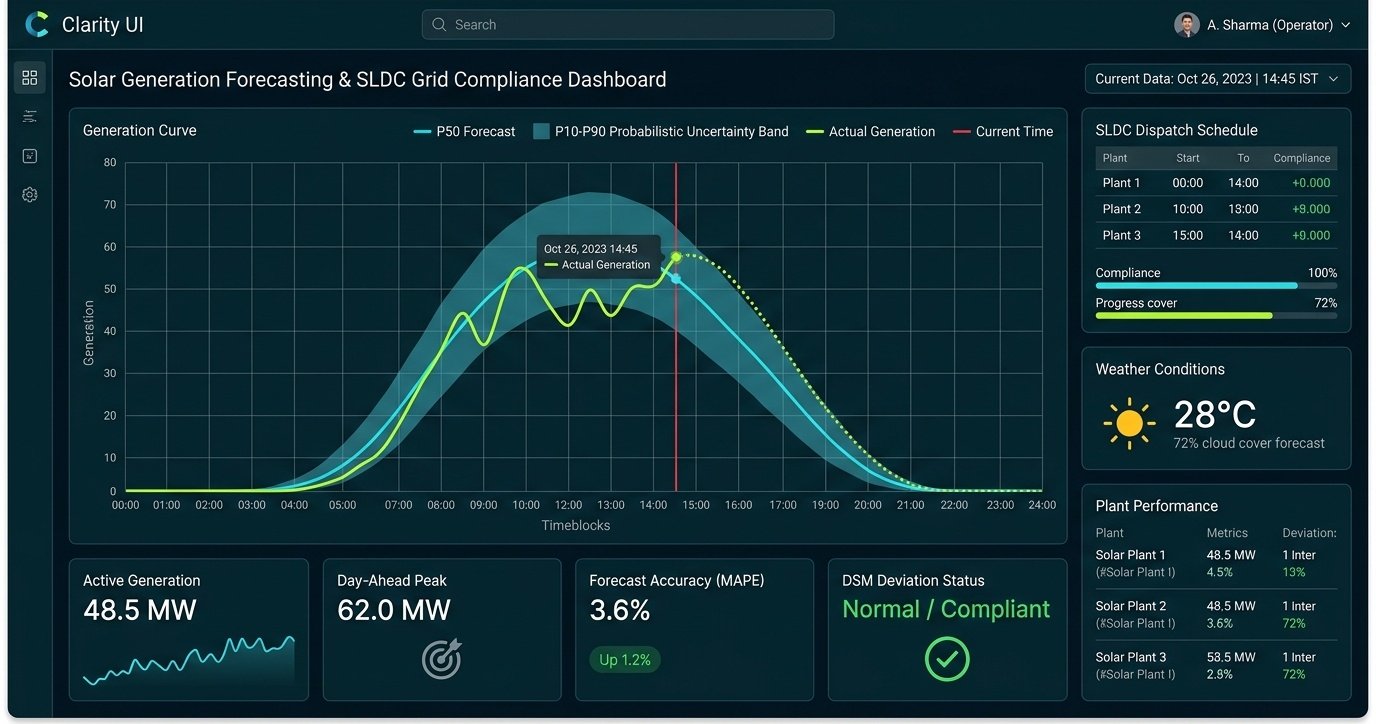
Fleet-wide supervisory platform delivering 15-minute Day-Ahead generation forecasting support, sensorless empirical soiling analytics, and automated generation reporting across distributed assets.
PHYSICS-INFORMED INTELLIGENCE
AI in Renewable Operations
Actionable operational intelligence combining high-resolution plant telemetry with physics-based electrical models.
Day-Ahead Generation Forecasting
Combines plant electrical topology with numerical weather data to generate 15-minute generation schedules to support applicable CERC DSM scheduling workflows. Explore Forecasting →
Sensorless Soiling Loss Analytics
Physics-guided machine learning helps distinguish soiling-related loss from longer-term equipment degradation, assisting O&M teams to plan module washing without extra optical sensors. Explore Soiling Analytics →
Real-Time Edge Anomaly Detection
Deterministic edge rule checks and physics-informed models flag operating patterns consistent with string shading, fuse faults, or tracker misalignment in real time.
Predictive Asset Health Tracking
Correlates transformer thermal dynamics and BESS cell delta-V telemetry to support earlier maintenance planning and track long-term component health.
ENGINEERING DELIVERY PROCESS
Engineered for Deployment, Not Just Monitoring
From single-line diagram (SLD) review to live commissioning, our delivery model is built around rigorous engineering discovery, interface mapping, and site acceptance testing (SAT).
01. Frame & Discover
Review the plant single-line diagram (SLD), OEM inverter models, weather sensors, revenue meters, and SLDC grid compliance specifications.
02. Map & Configure
Map Modbus register tables, configure Synapse Edge controller I/O point lists, build SCADA SLD screens, and calibrate PPC control loop setpoints.
03. Validate & Commission
Execute Factory Acceptance Testing (FAT), site wiring verification, SLDC telemetry signal validation, and live closed-loop ramp-rate testing.
CREDIBILITY BY DESIGN
Engineering Evidence Over Marketing Promises
Reliable solar SCADA and BESS EMS deployment begins with an inspectable system architecture, verified point lists, and clear technical requirements.
SLD & Point-List Review
Plant single-line diagram boundaries, telemetry data sources, physical signal interfaces, and command authority.
Interface & Register Maps
OEM Modbus registers, IEC 60870-5-104 / IEC 61850 protocols, deterministic polling cadences, and write permission safety gates.
FAT & SAT Commissioning Records
Factory acceptance test logs, closed-loop response measurements, failsafe fallback behavior, and site commissioning records.
TECHNICAL QUESTIONS
Technical Questions: SCADA and EMS for Solar, PPC & BESS
Key technical answers for solar EPCs, IPP asset managers, and grid engineers.
What is the difference between SCADA and EMS for solar and BESS plants?
Solar SCADA provides centralized plant monitoring, alarm logging, and high-frequency inverter telemetry acquisition. An Energy Management System (EMS) actively coordinates battery storage dispatch, state-of-charge (SoC) balancing, peak shaving, ToD tariff arbitrage, and hybrid power scheduling.
Can Enercog integrate with existing inverters & meters?
Synapse Edge Controllers support SunSpec Modbus, project-specific OEM register maps, IEC 60870-5-104, IEC 61850 and DLMS. Final device compatibility is confirmed against the named OEM model, available register documentation and project point list.
Does the Solar PPC require cloud connectivity to operate?
No. Enercog’s Power Plant Controller (PPC) executes active and reactive power curtailment loops deterministically on local Synapse hardware with sub-second response times, operating independently of internet or cloud connectivity.
How are SCADA, PPC, EMS, BMS/PCS, and protection separated?
Responsibilities follow strict control boundaries: SCADA handles visibility and operator supervision; the PPC executes high-speed active and reactive power control at the point of common coupling (PCC); the EMS manages multi-hour dispatch schedules and revenue stacking; the BMS and PCS govern battery safety, cell balancing, and electrical power conversion; and independent protection relays and switchgear remain responsible for electrical protection and trip functions. Review our BESS Responsibility Matrix for detailed interface boundaries.
READY TO DISCUSS YOUR PROJECT?
Bring Your Plant Single-Line Diagram. We’ll Bring the Architecture.
Share your plant requirements, existing equipment list, or single-line diagram (SLD). Our controls engineering team will prepare an interface map, point list, and technical architecture review for your solar SCADA, BESS EMS or hybrid power project.