CAPTIVE HYBRID GENERATOR & SOLAR PV CONTROL
DG / Gas / Solar Synchronization: 6 Control Pillars for Zero Reverse Power & Fuel Savings
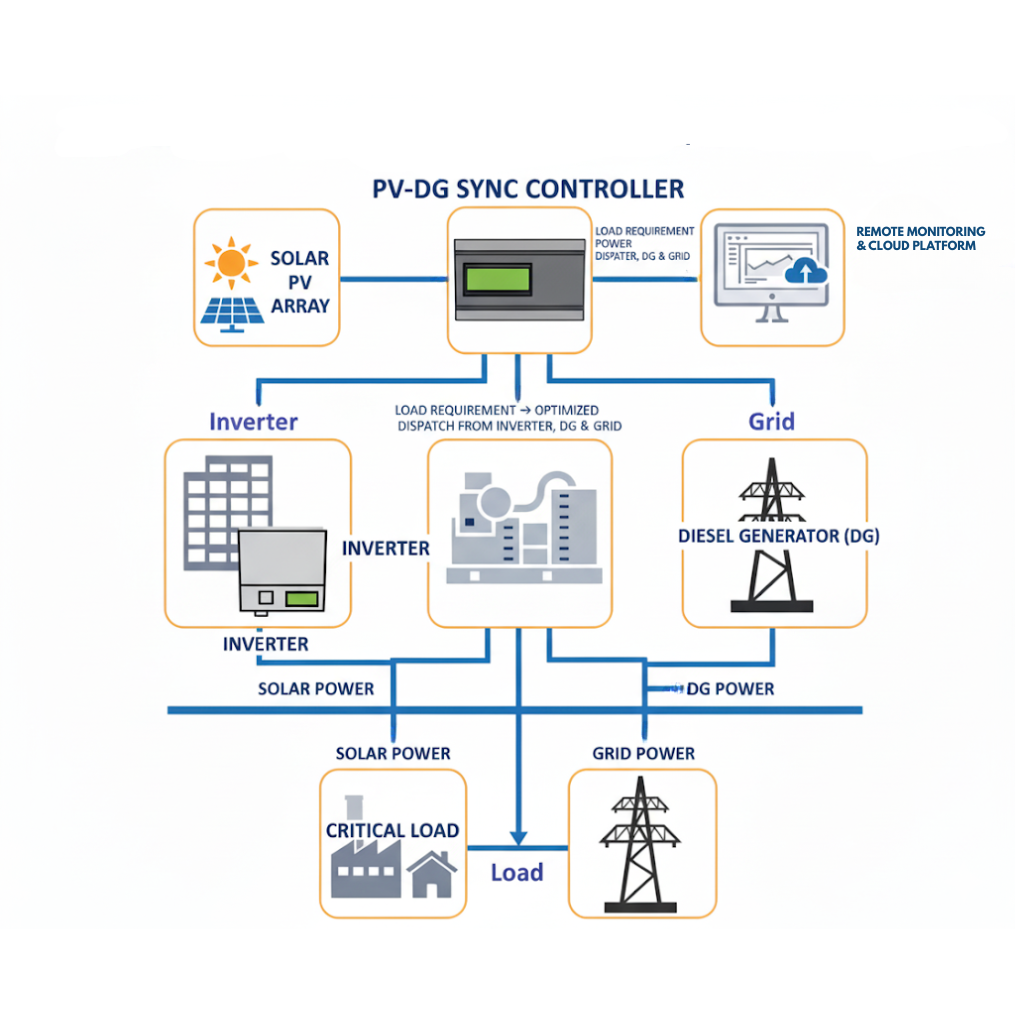
Enercog’s Synapse edge controller delivers real-time autonomous DG, gas, and solar synchronization for industrial captive power plants worldwide. Interfacing directly with generator controllers and solar inverters over Modbus TCP/RTU, it prevents alternator reverse power trips (ANSI 32) while strictly maintaining configured Minimum Generator Loading (MGL) to maximize clean fuel displacement.
Enterprise Capabilities
6 Essential Control Pillars for DG, Gas & Solar PV Microgrid Synchronization
Enercog’s DG solar synchronization controller unifies generator protection, fast inverter setpoint throttling, and multi-asset load sharing into a deterministic, fail-safe edge architecture within the Enercog Product Portfolio.
Pillar 01 — Reverse Power Protection
Sub-Second Reverse Power Prevention (ANSI 32)
Continuous closed-loop telemetry dynamically curtails solar active power before backfed energy reaches generator alternators.
- Active Throttling: Sub-second inverter modulation across Modbus channels.
- ANSI 32 Mitigation: Prevents alternator motoring and nuisance breaker lockouts.
- Engine Safety: Safeguards crankshafts, alternator windings, and turbochargers.
Pillar 02 — Engine Longevity
Configurable 30%–35% MGL Baseline Enforcement
Maintains optimal engine operating temperature by ensuring generators carry their OEM-specified minimum baseline load, configured to site engineering specifications.
- Anti-Wet Stacking: Eliminates unburnt fuel soot and exhaust carbon buildup.
- Bore Glazing Prevention: Preserves cylinder lubrication and piston ring sealing.
- OEM Compliance: Keeps engines within factory thermal and warranty envelopes.
Pillar 03 — Multi-Vendor Interfacing
Multi-OEM Inverter Fleet Coordination
Standardizes active power curtailment across heterogeneous string and central solar inverters from global manufacturers.
- Pre-Built Drivers: Plug-and-play for Sungrow, Huawei, SolarEdge, SMA, GoodWe.
- Ramp Regulation: Smooth power setpoint dispatch preventing voltage flickers.
- Plant Telemetry: High-resolution polling via Synapse Edge RTU.
Pillar 04 — Microgrid Protection
Multi-Generator Microgrid Coordination
Automatically balances solar throttling when multiple diesel or gas generators operate in parallel on a shared bus.
- Online Unit Sensing: Detects running gen-sets in real time via busbar meters.
- Dynamic MGL Scaling: Adjusts collective solar limit as generators cycle.
- Busbar Stability: Prevents cross-current hunting across parallel alternators.
Pillar 05 — Dynamic Headroom
Transient Step-Load & Headroom Buffer
Built-in active power headroom cushions running engines against sudden industrial load drops and cloud intermittency.
- Transient Cushion: Absorbs large motor shutoffs and compressor trip surges.
- Cloud Intermittency: Smooth transition as engine governors pick up load.
- PPC Coordination: Seamlessly links with Solar SCADA PPC.
Pillar 06 — Edge Independence
Autonomous Local Edge Resilience
Executes 100% offline on industrial DIN-rail hardware with zero external internet or cloud dependency.
- Industrial RTU: Optically isolated serial ports with hardware watchdog timer.
- 90-Day Buffering: Stores timestamped fuel offset logs during network outages.
- Clarity Sync: Streams analytics to Clarity Monitoring UI upon reconnection.
Plant Integration & Demarcation
Clear Responsibility Boundaries Across Captive Power Plant Assets
How the Synapse DG-PV Controller interfaces with generator controllers, metering hardware, and solar string inverters without overlapping physical protection layers.
Primary engine speed governing, automatic voltage regulation (AVR), synchronization checks, and ANSI 32 reverse power breaker trips remain governed by OEM controllers (DSE, ComAp, Woodward, DEIF). Synapse reads telemetry and dispatches supervisory power limits to solar inverters without overriding native engine trip logic.
Executes the real-time closed-loop dispatch algorithm on industrial ARM hardware. Continuously polls generator active power and plant demand to compute and broadcast active power throttling setpoints across multiple RS-485 / Ethernet inverter channels.
Executes dynamic active power ramp-down according to received percentage or absolute power limits over SunSpec Modbus TCP/RTU. Supports string and central inverters from Sungrow, Huawei, SolarEdge, SMA, Growatt, GoodWe, Delta, and Solis.
Receives buffered, non-volatile telemetry records to generate audit-grade diesel fuel savings reports, heat rate tracking, solar performance ratio (PR), and automated maintenance alerts for plant engineering teams.
Hardware Architecture & Interfacing
Modular Hardware Specifications & Multi-OEM Compatibility Matrix
Pre-tested protocol drivers enable seamless plug-and-play integration across leading industrial gen-set controllers, commercial solar string inverters, and high-precision power meters.
| Equipment Category | Supported Manufacturers & Models | Protocol & Polling Rate | Control / Interfacing Scope |
|---|---|---|---|
| Diesel & Gas Gen-Set Controllers | Deep Sea Electronics (DSE 8610, 7320, 8620, 8660), ComAp (InteliGen NT, InteliCompact, InteliLite), Woodward (easYgen 2000/3000 series), DEIF (AGC-4, CGC-400, ASC-4), Schneider, Cummins PowerCommand | Modbus RTU / TCP (500ms–1s serial, <500ms TCP) | Gen-set active power, reactive power, frequency, fuel level, engine RPM, run-hours, breaker status |
| Solar PV String & Central Inverters | Sungrow (SG series), Huawei (SUN2000), SolarEdge, SMA (Sunny Tripower), Growatt (MAX series), GoodWe (SDT/SMT), Delta, Fimer / ABB, Sineng, Solis, Kehua | SunSpec Modbus TCP / RTU (Sub-second setpoint dispatch) | Dynamic active power throttling setpoints (0–100%), reactive power setpoints, ramp-rate limitation |
| Class 0.2s Multi-Function Meters | Schneider (PM5000, PM8000, ION7650), Secure (Elite 440), Rishabh, L&T (WL series), Yokogawa, Selec | RS-485 / Modbus RTU / Ethernet | Bidirectional energy flow, instantaneous kW demand, power factor, harmonic monitoring |
| Tier 1: Synapse Edge Hardware | Quad-core ARM Cortex processor, configurable 2 GB, 4 GB, or 8 GB LPDDR4 RAM, 4x isolated RS-485 ports, dual GbE ports | 35mm DIN-rail (0°C to 60°C) | Autonomous local edge closed-loop engine; sub-second cycle time; 90-day non-volatile local storage |
| Tier 2: Ruggedized Field Panels | Pre-wired IP65 / IP66 industrial mild-steel or polycarbonate enclosure with integrated backup UPS and surge arrestors | Turnkey Field Panel (-20°C to +70°C) | Engineered for harsh industrial captive plants, high ambient desert sites, and dusty manufacturing switchyards |
Turnkey Captive Control Engineering
Enercog provides end-to-end electrical design, custom pre-wired control panels, CT/PT selection, and on-site FAT/SAT commissioning for hybrid industrial microgrids.
Implementation Protocol
4-Stage Project Scoping, Engineering & Commissioning Workflow
Our structured engineering delivery model ensures minimal disruption to manufacturing operations while achieving proven generator protection and maximum fuel savings.
Site SLD & Controller Audit
Comprehensive review of captive power plant single-line diagrams, generator controller firmware, CT/PT ratios, and inverter communication wiring to design the optimal closed-loop topology.
Pre-Wired Panel Fabrication
Configuration of Synapse controller firmware with site-specific MGL thresholds, assembly of pre-wired IP65 enclosures with surge protection and backup UPS, and complete factory acceptance testing (FAT).
Step-Load Testing & Tuning
On-site commissioning: test communication loops, simulate artificial load rejection, fine-tune inverter curtailment ramp rates, and verify zero reverse flow into gen-sets during transient step-loads.
Handover & Telemetry Live
Handover of as-built SLDs, activation of real-time fuel offset dashboards on Clarity UI, and configuration of automated daily performance reports and maintenance alerts for plant operations.
Frequently Asked Questions
Frequently Asked Questions About DG & Gas Solar Synchronization
Answers to critical engineering, regulatory, and commercial questions regarding captive hybrid diesel-gas-solar synchronization.
What is DG and gas solar synchronization and why is it essential for captive plants?
DG and gas solar synchronization refers to the automated closed-loop coordination of captive diesel or gas generators with rooftop or ground-mounted solar PV systems operating behind the meter.
It is essential because conventional generators cannot absorb backfed power. Uncontrolled solar generation exceeding plant demand triggers alternator reverse power trips (ANSI 32), while running generators below 30% capacity causes severe engine carbon buildup (“wet stacking”). Enercog’s controller dynamically modulates solar output to maintain generator stability and maximize fuel savings per Central Electricity Authority (CEA) guidelines.
How does the controller enforce Minimum Generator Loading (MGL)?
The Synapse controller continuously reads the total facility demand from Class 0.2s multi-function meters. It modulates solar active power setpoints to ensure running generators always carry their required baseline load.
If plant demand drops, the controller curtails solar inverter output via Modbus TCP/RTU setpoint commands, keeping the generator at its optimum operating temperature and preventing wet stacking.
What happens during sudden factory step-load drops or cloud passing?
During abrupt factory load drops (e.g. large induction motor trips), the high-speed controller issues immediate priority throttling commands to inverters, supported by a 5%–10% safety headroom cushion to absorb transients without tripping gen-set breakers.
During cloud cover, solar generation drops naturally, and the generator’s internal governor smoothly ramps up to supply the deficit without voltage sag.
Which generator controllers and solar inverters are natively supported?
The system features pre-configured protocol drivers for all major generator controllers—including Deep Sea Electronics (DSE 8610, 7320, 8620), ComAp (InteliGen, InteliCompact), Woodward (easYgen series), DEIF (AGC-4, ASC-4), Schneider, and Cummins.
On the solar side, it supports all SunSpec-compliant and proprietary Modbus inverters from Sungrow, Huawei, SolarEdge, SMA, Growatt, GoodWe, Delta, Fimer, Sineng, and Solis.
Can the system synchronize multiple diesel and gas generators in parallel?
Yes. Enercog’s hybrid controller supports complex multi-generator configurations. It monitors total powerhouse active and reactive power, balancing curtailment commands across inverters while coordinating with gen-set synchronizers.
It dynamically detects active generator units on the bus, scaling the collective protection threshold so all running units remain fully protected at peak fuel efficiency.
What diesel fuel savings and payback timeline can industrial facilities achieve?
Facilities operating daytime diesel or gas generators can achieve an engineered model range of 30% to 55% reduction in daytime fuel consumption, depending on solar PV capacity relative to baseline facility demand and OEM minimum generator loading constraints.
Given current industrial diesel costs, most captive industrial plants achieve full capital payback on the synchronization and control system within 4 to 8 months of commissioning.
GET STARTED
Ready to Prevent Reverse Power Trips & Maximize Generator Fuel Savings?
Connect with Enercog’s power engineering team. We review your captive plant single-line diagram, generator controllers, and solar array capacity to deliver an engineered hybrid synchronization solution.