
PREDICTIVE GRID INTEGRATION & SCHEDULING SUPPORT
SLDC Forecasting India & 15-Minute Grid Scheduling Support
Accurate SLDC forecasting India operations require precise 15-minute generation profiles aligned with grid compliance standards. Enercog’s analytics platform integrates on-site weather monitoring feeds and satellite irradiance data to model 96-block generation schedules, track real-time deviations, and enable Qualified Coordinating Agencies (QCAs) and DSC-registered entities to coordinate grid commitments effectively.
Built as a technology enablement layer for DSC-registered agencies and plant operators coordinating SLDC forecasting India schedules, providing 96-block day-ahead scheduling, intra-day revision modeling, and CERC DSM deviation visibility.
Closed-Loop 15-Minute Solar Forecasting & Dispatch Flow
Integrated forecasting telemetry: On-site WMS and meteorological feeds ingest into the Cortex Forecasting Core, generating compliant 96-block generation profiles that enable DSC-registered agencies to execute schedule submission and DSM variance tracking.
REGULATORY COMPLIANCE & GRID REALITIES
Key Challenges in Solar Forecasting and Grid Scheduling Support
Grid-connected renewable energy generators across India operate under dynamic regulatory frameworks established by the Central Electricity Regulatory Commission (CERC) and State Electricity Regulatory Commissions (SERCs). Managing daily commitments requires high-resolution meteorological models integrated with live plant telemetry to maintain compliant SLDC forecasting India operations.
Deviation Settlement Mechanism Exposure
Renewable generators must adhere to approved grid code tolerance bands. Generation that deviates significantly from scheduled commitments incurs commercial deviation settlement charges, directly affecting plant revenue.
- Financial exposure linked to real-time grid frequency and reference tariffs
- Regulatory accountability managed by designated DSC-registered agencies
- State-specific regulations (MERC, GUVNL, RERC, APERC, TNERC) with distinct deviation schedules
Weather Volatility & 15-Minute Revisions
Solar generation shifts rapidly during transient cloud passages and localized weather swings. Static day-ahead projections require regular intra-day schedule updates submitted ahead of regional freeze deadlines.
- Standard 96 time-block generation commitments submitted daily
- Periodic intra-day revisions permitted under applicable state grid codes
- Automated data formatting to prevent manual submission delays
Pooling Substation (PSS) Multi-Generator Allocation
When multiple solar or wind developers evacuate through a common Pooling Substation (PSS), SLDCs assess net deviation charges on the collective pool, requiring transparent de-pooling across individual SLDC forecasting India plant participants.
- Capacity-based de-pooling models aligned with contracted peak capacity
- Generation-based de-pooling utilizing synchronized ABT meter data
- Clear commercial statements for joint developer reconciliation
SYSTEM INTEGRATION WORKFLOW
End-to-End Solar Forecasting & SLDC Dispatch Architecture
Enercog connects on-site weather stations and plant SCADA telemetry directly with the Cortex cloud analytics engine, generating 15-minute generation profiles formatted for automated SLDC forecasting India agency submission.
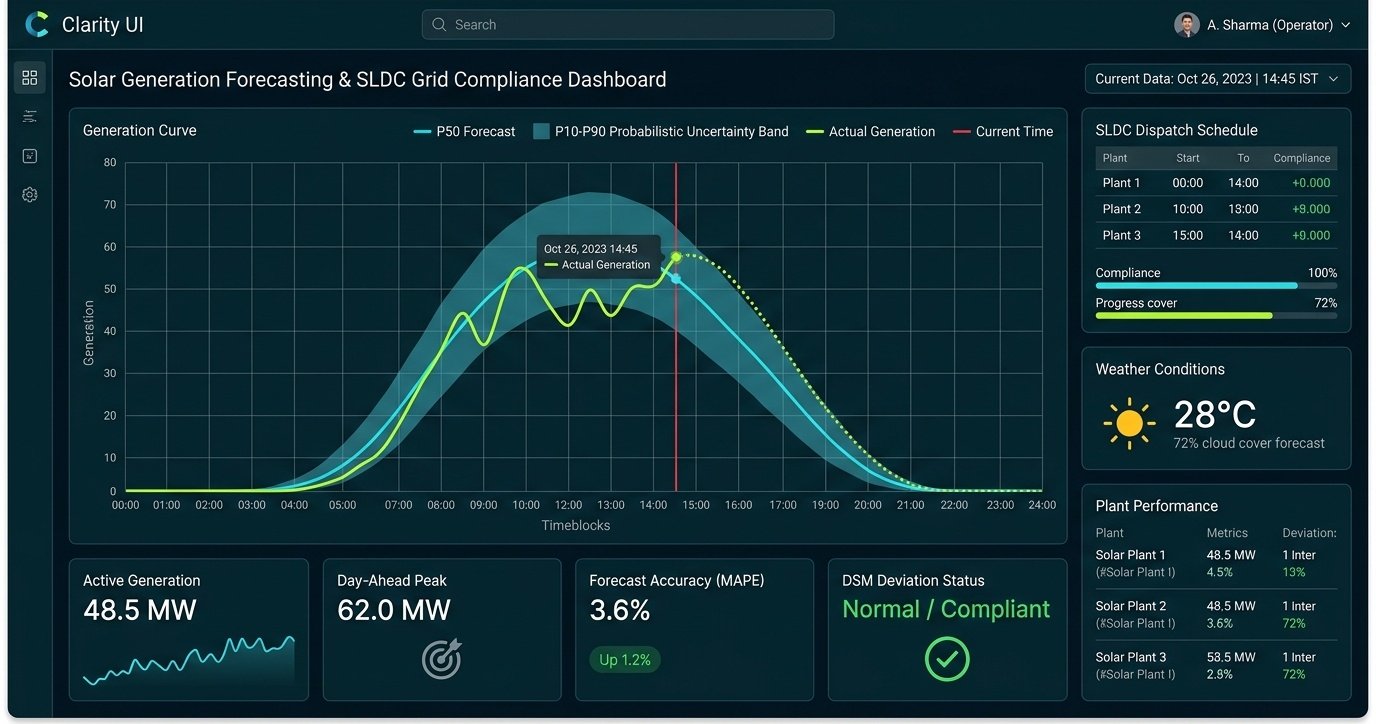
Figure 2: Closed-Loop Solar Forecasting, Telemetry & SLDC Settlement Architecture. Ingests meteorological feeds and on-site Synapse WMS sensors, executes generation modeling in Cortex Cloud AI, and delivers compliant 96-block XML/CSV schedules for SLDC forecasting India agency submission alongside real-time DSM tracking on Clarity UI.
ENGINEERING CAPABILITIES
6 Operational Pillars of SLDC Forecasting India Support
Designed specifically for utility solar farms, C&I open-access portfolios, and wind-solar hybrid microgrids across India.
Multi-Source Meteorological Telemetry
Combines high-resolution meteorological models with satellite irradiance data to model cloud movement and solar irradiance across individual plant coordinates.
- Global Horizontal Irradiance (GHI) and Plane-of-Array (POA) irradiance modeling
- Temperature, relative humidity, and wind velocity derating curves
- Dynamic spatial adaptation tailored to plant geographic locations
96-Block Generation Scheduling
Generates 96 time-block power generation profiles at 15-minute intervals for day-ahead commitments, supported by intra-day re-forecasting based on live on-site telemetry.
- Day-ahead schedule generation prepared ahead of standard morning deadlines
- Intra-day schedule revision support aligned with state grid code intervals
- Accounts for plant availability and inverter conversion parameters
DSC Agency & SLDC Integration Support
Provides standardized schedule formatting for DSC-registered agencies and QCAs coordinating SLDC forecasting India commitments across state load despatch centers.
- Export in standard data formats (CSV, XML, or Web API)
- Detailed scheduling logs for audit trails and operational records
- Compatible with diverse regional reporting requirements
DSM Deviation & Variance Tracking
Compares live generation telemetry against active scheduled blocks in real time, providing plant operators with immediate visibility into deviation trends.
- Real-time forecast vs. actual variance dashboards on Clarity UI
- Automated operational alerts when generation approaches tolerance thresholds
- Coordinates with plant control systems when curtailment is required
Pooling Substation (PSS) De-Pooling Oversight
Enables transparent commercial allocation for shared pooling substations evacuating multiple solar and wind generation assets.
- Capacity-based de-pooling models aligned with contracted MW peak capacity
- Actual-generation-based de-pooling utilizing synchronized meter timestamping
- Structured commercial statements for joint developer reconciliation
Solar-Plus-BESS Co-Located Dispatch
Coordinates joint generation schedules for solar installations co-located with Battery Energy Storage Systems (BESS), supporting firm dispatch commitments.
COMMERCIAL SETTLEMENT MECHANICS
CERC Deviation Settlement Mechanism (DSM) & PSS De-Pooling Models
Under Indian grid regulations, deviation charges assessed at a common pooling bus are de-pooled across individual generators to ensure transparent commercial accountability across SLDC forecasting India asset clusters.
Capacity-Based De-Pooling Allocation
Distributes total pooling substation DSM deviation charges in direct proportion to each developer’s installed DC/AC capacity connected to the pooling bus.
Commonly adopted in uniform solar parks where asset specifications and irradiance profiles are homogeneous across all participating developer blocks.
Actual-Generation-Based De-Pooling Allocation
Distributes net deviation penalties based on each generator’s synchronized actual energy generation during the specific 15-minute settlement time block.
Recommended for hybrid pooling substations combining wind and solar assets, or when developers experience disparate localized cloud passages and equipment outages.
HARDWARE TELEMETRY & WMS INTEGRATION
Modular Weather Station (WMS) Telemetry & Edge Gateway Specifications
High-accuracy solar generation forecasting relies on calibrated on-site meteorological sensors. Enercog provides industrial edge controllers for seamless field sensor acquisition per Central Electricity Authority (CEA) technical standards for SLDC forecasting India solar assets.
| Deployment Tier | Hardware Form Factor & Architecture | Target Application Scope |
|---|---|---|
| Tier 1: Standard Industrial Edge Gateway (Synapse Series) | 35mm DIN-rail industrial controller, quad-core ARM Cortex processor, configurable 2 GB / 4 GB / 8 GB RAM tiers, 4x isolated RS-485/CAN interfaces, dual Gigabit Ethernet, wide operating temperature (-20°C to +70°C). | On-site Weather Monitoring Station (WMS) acquisition (Pyranometer POA/GHI, Modbus temperature sensors, anemometers), C&I open-access solar plants (<25 MW), and rooftop commercial solar portfolios. |
| Tier 2: Utility-Scale Server Deployment (Project-Engineered) | 1U/2U 19-inch rackmount industrial servers with 1+1 hot-standby automated failover (<500ms heartbeat), dual redundant hot-swappable AC/DC power supplies, ECC RAM, and local non-volatile historian storage. | Utility-scale solar power plants (>50 MW), wind-solar hybrid parks, pooling substations (PSS), and tenders enforcing mandatory 1+1 redundant SLDC telemetry and historian retention per CEA guidelines. |
FREQUENTLY ASKED QUESTIONS
Frequently Asked Questions on SLDC Forecasting India
Common technical, regulatory, and commercial inquiries regarding renewable energy forecasting, scheduling, and DSM variance management.
What regulatory frameworks govern SLDC forecasting India solar installations?
Solar forecasting and scheduling in India are governed by regulations issued by the Central Electricity Regulatory Commission (CERC)—specifically the Indian Electricity Grid Code (IEGC) and Deviation Settlement Mechanism (DSM) regulations—alongside state-level SERC grid codes (e.g. MERC, GUVNL, RERC).
Under these frameworks, grid-connected renewable generators must submit 15-minute generation commitments and operate within specified tolerance bands to maintain grid stability.
How does Enercog support DSC-registered agencies with solar forecasting?
Enercog acts as a technology enablement layer for designated Digital Signature Certificate (DSC) registered agencies and Qualified Coordinating Agencies (QCAs).
The platform generates compliant 96-block generation profiles, models intra-day revisions, and tracks real-time generation variances, allowing authorized agencies to review and submit schedules smoothly to state dispatch portals.
How many intra-day schedule revisions can be submitted daily?
Most state grid codes allow multiple intra-day schedule revisions structured in 15-minute time blocks. Revisions typically become effective following a mandatory notice window (often starting from the 4th to 6th time block ahead) after submission.
Cortex AI continuously tracks on-site weather feeds to update generation profiles, allowing operators and agencies to adjust commitments before regional revision gates close.
Why is on-site WMS telemetry critical compared to satellite data alone?
While geostationary weather satellites provide valuable regional cloud patterns, their spatial and temporal resolutions cannot always capture immediate localized cloud cover directly over a specific solar park.
On-site Weather Monitoring Stations (WMS) equipped with calibrated pyranometers (measuring GHI and POA) and module temperature sensors capture real-time irradiance shifts at sub-minute intervals, enabling accurate intra-day profile adjustments.
How does Pooling Sub-Station (PSS) de-pooling work for shared infrastructure?
When multiple solar or wind developers evacuate through a common pooling station, the SLDC issues a single consolidated DSM bill for the overall interconnection bus.
Enercog’s de-pooling module calculates individual developer obligations using either Capacity-Based De-Pooling (proportional to contracted plant capacity) or Actual-Generation-Based De-Pooling (proportional to synchronized meter readings), ensuring fair commercial settlement.
Can the platform support co-located Solar-Plus-BESS installations?
Yes. Enercog’s forecasting architecture coordinates joint generation and storage schedules.
For solar plants equipped with Battery Energy Storage Systems (BESS), the system integrates with BESS EMS to schedule battery charge and discharge cycles, dampening solar ramp rates and meeting firm dispatch targets.
Schedule an SLDC Forecasting India & DSM Scoping Review for Your Plant
Connect with Enercog’s power systems engineering team to review your plant Single Line Diagram (SLD), evaluate current DSM deviation risks, and scope an automated 15-minute SLDC forecasting India solution.