
Enterprise Energy Management System (EMS)
Energy Management Systems for Solar, BESS and Hybrid Plants
Industrial-grade EMS software and edge controller runtime within Enercog’s energy management platform, engineered for multi-asset scheduling, peak demand management, solar-plus-storage firming, and utility grid compliance within a project-validated plant boundary.
Multi-Asset Supervisory EMS Architecture
Interleaved priority active & reactive power commands with deterministic local controller execution.
Coordinated operating modes across Solar PV, BESS storage, DG synchronization, and grid metering.
From in-house Synapse edge controllers to 1+1 redundant rackmount server clusters compliant with Indian grid tender specs.
Core Capabilities
6 Industrial Energy Management Operating Modes
An energy management system (EMS) coordinates plant-level operating strategies across solar, storage, and grid interconnections without replacing deterministic local equipment protection.
Solar-Plus-Storage Firming
Smooths steep solar PV ramp rates and mitigates cloud intermittency by dynamically charging or discharging storage within inverter capabilities.
Ramp ControlPeak Demand Shaving
Caps facility peak import demand at the point of interconnection (POI) to prevent expensive contract demand breach penalties and demand charges.
Demand LimitingTime-of-Day (ToD) Arbitrage
Schedules automated battery charging during low-tariff solar hours and controlled injection during peak-tariff evening industrial demand slots.
Tariff OptimizationZero-Export & DG Sync
Throttles generation or diverts excess energy to storage behind-the-meter, preventing reverse power flow into diesel generators or the grid.
Behind-The-MeterReserve Allocation & SoC
Guarantees critical emergency backup reserves, enforces battery depth-of-discharge boundaries, and schedules periodic cell balancing windows.
Health ManagementPOI Reactive Power Control
Coordinates inverter reactive power setpoints (kVAR) and voltage support at the grid substation to maintain power factor compliance per CEA technical standards.
Grid SupportSystem Boundary & Governance
Clear Control Boundaries & Multi-Tier Responsibilities
Supervisory EMS software coordinates strategy, schedules, and targets while deterministic sub-second protection remains strictly with local controllers.
Fail-Safe Telemetry & Stale Data Handling
When network dropouts or stale meter readings occur, the EMS automatically identifies signal uncertainty, prevents blind command replay, and transitions connected systems into an approved project safe state. For an in-depth breakdown of equipment interfaces, consult our BESS EMS vs BMS, PCS, PPC, and SCADA Responsibility Guide.
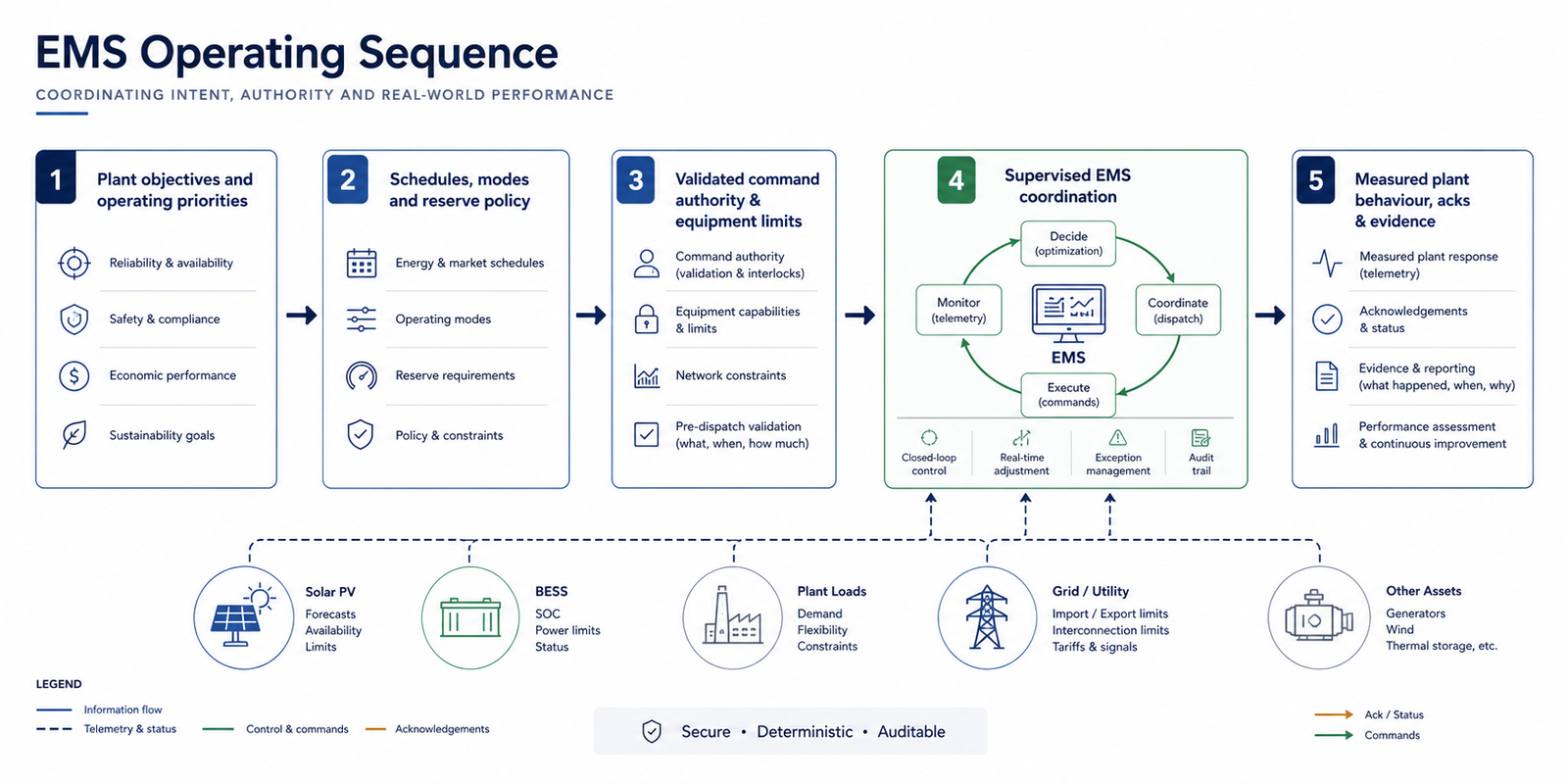
Owns plant-level operating modes, ToD schedules, peak shaving setpoints, reserve allocation, and priority command arbitration across connected generation and storage assets.
Executes sub-second closed-loop active power curtailment, reactive power/voltage control, and SLDC frequency response per CEA grid connectivity regulations.
Enforces cell voltage/temperature limits, DC overcurrent trips, IGBT firing protection, and autonomous thermal management within manufacturer warranty specifications.
Provides independent anti-islanding, breaker tripping, and revenue-grade 15-minute bidirectional metering at the point of interconnection (POI).
Scalable Compute Architecture
Scalable Deployment Form Factors: Industrial Edge to Utility Server Clusters
Enercog adapts its EMS runtime to plant scale—from ruggedized DIN-rail Synapse controllers for distributed C&I to 1+1 hot-standby redundant rackmount servers for utility transmission substations.
Synapse Industrial Edge Controller
Standard in-house hardware baseline for C&I solar-plus-storage, behind-the-meter zero export, and container-level edge gateways (<25 MW/MWh).
- Form Factor35mm DIN-Rail / Fanless IP20/IP65 Panel
- Compute CoreQuad-Core ARM Cortex Architecture
- System MemoryConfigurable 2 GB / 4 GB / 8 GB RAM*
- Field Serial Ports4x Isolated RS-485/CAN (4kV Optical Isolation)
- Ethernet PortsDual 10/100/1000 Mbps (OT/IT Network Separation)
- Local BufferingUp to 3 Months Non-Volatile Telemetry
- Operating Temp-20°C to +70°C Extended Industrial
Enterprise Redundant Server Infrastructure
Project-engineered deployment topology for utility-scale solar-plus-storage plants (>50 MW/100 MWh) and tenders mandating 1+1 high availability.
- Form Factor1U / 2U 19-inch Industrial Rackmount Server
- High Availability1+1 Hot-Standby Automated Failover
- Power RedundancyDual Hot-Swappable AC/DC PSUs (Dual UPS)
- Compute & MemoryMulti-Core Enterprise Processor / 16–64 GB ECC
- Network RedundancyQuad Gigabit NICs with Redundant Bonding
- Local HistorianHigh-IOPS Enterprise RAID NVMe Telemetry Storage
- Tender ComplianceSECI, NTPC, State DISCOM & SLDC Protocols
Project Delivery
6-Stage Commissioning & Grid Integration Workflow
A structured engineering methodology carrying project requirements from initial SLD review through Factory Acceptance Testing (FAT) to utility grid handover.
SLD & Asset Review
Auditing Single Line Diagrams, transformer ratings, inverter schedules, meter locations, and grid interconnection limits.
Control Philosophy
Establishing priority matrices, interlocks, local/remote authority rules, SoC safety margins, and fail-safe fallback policies.
OEM Protocol Mapping
Configuring register maps across multi-brand inverters, BMS batteries, PCS units, ABT meters, and SLDC IEC 60870-5-104 channels.
FAT & Interface Testing
Simulating multi-asset operating scenarios, communication dropout recovery, and setpoint dispatch in a controlled test environment.
SAT & Grid Commissioning
On-site field verification, step-response tuning, zero-export proving, and DISCOM/SLDC grid telemetry validation.
Audit Trail & Handover
Final documentation delivery, operator training, chronological event logging, and transition to long-term operational support with Cortex Cloud AI and Clarity UI.
Technical FAQ
Frequently Asked Questions About EMS Systems
Engineering clarity on energy management architecture, equipment boundaries, grid compliance, and project scoping.
What is the core difference between an EMS, SCADA, and a PPC?
Can the EMS execute peak shaving and tariff arbitrage simultaneously?
How does the EMS scale for utility plants requiring server redundancy?
What happens if communication fails between the EMS and inverters?
Does Enercog provide India-manufactured hardware for tender compliance?
What technical inputs are required to start an EMS project scoping review?
Project Engineering Review
Ready to Engineer Your Plant EMS Architecture?
Consult with our power systems engineers to review your plant SLD, define control philosophies, and deploy an India-built EMS solution tailored to your operational objectives.