PM-KUSUM Component A Telemetry Compliance: Solving DLMS Protocol and Store-and-Forward Network Challenges for Indian Solar IPPs
Utility-scale and distributed solar installations under the PM-KUSUM Component A scheme must comply with strict telemetry mandates. Securing timely billing approval from state utilities requires reliable data integration at remote grid points. This article breaks down the physical and protocol-level solutions to maintain grid telemetry compliance.
The Regulatory Mandate of PM-KUSUM Component A RMS
MNRE guidelines for PM-KUSUM Component A mandate real-time Remote Monitoring System (RMS) telemetry integration with state DISCOMs. IPPs must transmit 15-minute generation and inverter telemetry using DLMS/COSEM (IEC 62056) for meters and Modbus RTU (RS-485) for inverters. Failure to maintain 98% telemetry uptime results in billing and subsidy disbursement delays.
The Ministry of New and Renewable Energy (MNRE) outlines clear guidelines for feeder-level solar power plants ranging from 500 kW to 2 MW under Component A of the PM-KUSUM scheme. A primary compliance hurdle for independent power producers (IPPs) is the deployment of an approved Remote Monitoring System (RMS). This system must actively push continuous telemetry data to both the state distribution company (DISCOM) portal and the central MNRE monitoring platform.
DISCOMs utilize this telemetry data to verify actual energy generation, track system availability, and audit power quality parameters before clearing feed-in tariff invoices. Because billing cycles rely on continuous documentation, a lack of consistent telemetry results in direct payment suspensions. For many developers, establishing this link is an afterthought that stalls revenue generation for months post-commissioning.
The Core Challenge: DLMS Protocol and Remote Grid Dropouts
Technical hurdles in rural solar plants center on parsing complex DLMS/COSEM meter data and managing frequent GSM network dropouts. Standard RTUs fail to read DLMS OBIS codes or cache data locally. This results in telemetry gaps at the DISCOM server, triggering automated compliance alerts and delayed billing.
The first engineering obstacle is protocol mismatch. Solar inverters utilize industry-standard Modbus RTU or TCP protocols. However, secure billing energy meters at the substation interface communicate via DLMS/COSEM (Device Language Message Specification/Companion Specification for Energy Metering) over IEC 62056 standards. Standard remote terminal units (RTUs) or industrial gateways deployed by competitors lack native DLMS parsers, requiring complex external conversion hardware that introduces latency and points of failure.
The second challenge is network instability. PM-KUSUM installations are located on agricultural lands where cellular GSM networks are weak and prone to dropouts. When a network connection fails, typical telemetry systems lose active communication, causing missing data packets at the DISCOM database. Because the DISCOM algorithms flag any data gap as a non-compliance event, even a brief daily dropout can halt the invoice approval process.
Enercog Synapse Edge: Low-Latency iRTU for Compliant Grid Integration
Enercog Synapse Edge is an inverter-agnostic edge controller that resolves these compliance bottlenecks. It features native DLMS parser engines, multi-port RS-485 interfaces for Modbus RTU/TCP, and a local store-and-forward database caching up to 6 months of data. This ensures zero data loss during grid-network outages.
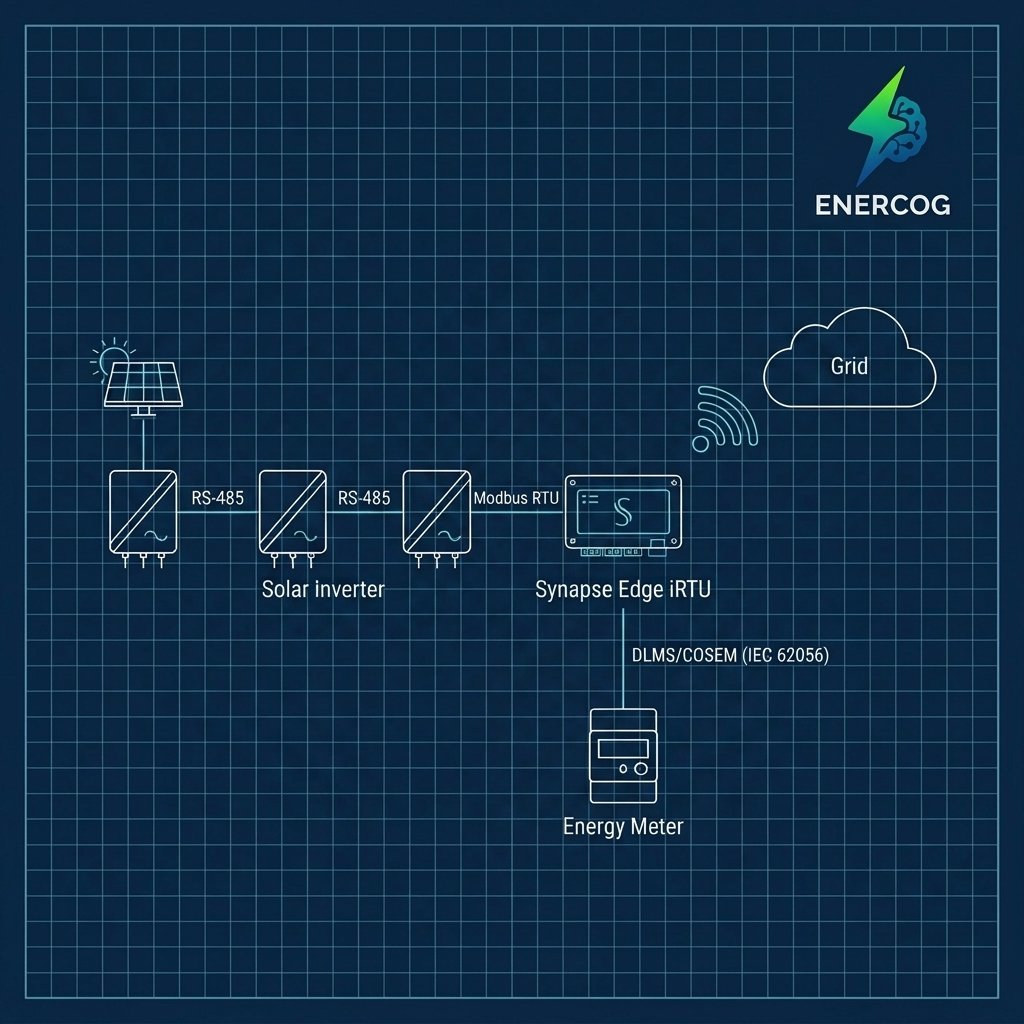
Enercog Synapse Edge is an intelligent remote terminal unit (iRTU) engineered for tough grid environments. It integrates direct DLMS protocol parsing for L&T, Secure, and Genus energy meters, eliminating the need for expensive third-party protocol converters. It daisy-chains site inverters via RS-485 Modbus RTU, acquiring string-level telemetry, active power output, and system temperature data in sub-seconds.
To address connectivity issues, Enercog Synapse Edge runs a local SQL-based database at the edge. The device caches up to 6 months of local telemetry logs to satisfy MNRE guidelines. When connection loss occurs, the device stores data chronologically. Once the 4G network is restored, Synapse Edge uses a store-and-forward mechanism to backfill the DISCOM and MNRE portals with correct historical timestamps. This guarantees that no generation data is permanently lost.
| Parameter / Feature | Traditional RTU Gateway | Enercog Synapse Edge iRTU |
|---|---|---|
| Meter Protocol Support | Modbus only (Requires external DLMS converter) | Native DLMS/COSEM (IEC 62056) |
| Data Caching Strategy | None or limited RAM buffer (Loss on reboot) | Local SQL Database (Up to 6 months of persistent logs) |
| Uptime Mechanisms | Single SIM, no local fallback | Dual-SIM 4G LTE Auto-Failover + store-and-forward |
| DISCOM Portal Integration | Manual configuration or custom scripts | Pre-configured API payloads for state utilities |
| Local Environmental Rating | Standard commercial (0°C to +50°C) | Industrial grade (-20°C to +70°C, IP65 enclosure) |
Cortex AI & Clarity UI: Proactive Telemetry Diagnostics
Enercog Cortex AI monitors telemetry health by analyzing data stream consistency and predicting communication dropouts. It visualizes local energy profiles and DISCOM feed status on Clarity UI. This lets operators verify that generation data is accurately received by Discom servers before the billing cycle close.
Beyond edge hardware, compliance requires cloud validation. Enercog Cortex AI ingests telemetry data from Synapse Edge and cross-checks the transmission integrity. If data packets fail to register at the DISCOM server due to API handshaking errors, Cortex AI flags the mismatch. It alerts plant operators via Clarity UI, preventing end-of-month surprises during invoice generation.
Clarity UI provides a dedicated compliance widget showing real-time network status, successful packets pushed, and active status of the DISCOM handshake. If an operator sees a discrepancy between local meter generation logs and DISCOM records, they can trigger manual backfills directly through the dashboard. This ensures the solar asset remains fully compliant and audit-ready.
“A telemetry gap of even four hours can delay tariff invoice approval by fifteen days under current DISCOM protocols,” explains Shrikant Meshram, CEO of Enercog. “We engineered Synapse Edge to treat the local storage as primary, ensuring every data point is backfilled with correct timestamps the moment the network recovers.”
This edge-first design works in parallel with our utility-grade Solar SCADA system, providing a robust backup interface that keeps smaller solar installations compliant under PM-KUSUM and associated grid codes.
Step-by-Step SOP for Deploying PM-KUSUM RMS Compliance
Configuring the Enercog Synapse Edge iRTU requires four key steps: physical mounting, Modbus inverter mapping, DLMS meter mapping, and DISCOM API registration. This standard operating procedure ensures a rapid, compliant commissioning process that satisfies state-level grid connection audits.
- Physical Mounting: Mount the Synapse Edge iRTU on a DIN rail in the ACDB or Main Control Room (MCR) panel, securing a stable 24V DC power feed.
- Daisy-chain Inverters: Connect all site inverters via RS-485 daisy-chains using twisted-pair shielded cable, configuring distinct Modbus ID addresses for each unit.
- Configure DLMS Energy Meter: Interface the main substation energy meter using its RS-485 connection, mapping the appropriate OBIS codes for import/export energy.
- DISCOM Credentials Setup: Open Clarity UI local configuration panel, insert the state utility API endpoints, upload SSL certificates, and configure 4G LTE settings.
- End-to-End Handshake Audit: Run the telemetry packet test through Clarity UI to verify successful transmission to the target DISCOM cloud database.
Great content! Keep up the good work!