BESS EMS vs BMS, PCS, PPC and SCADA: Control Responsibilities
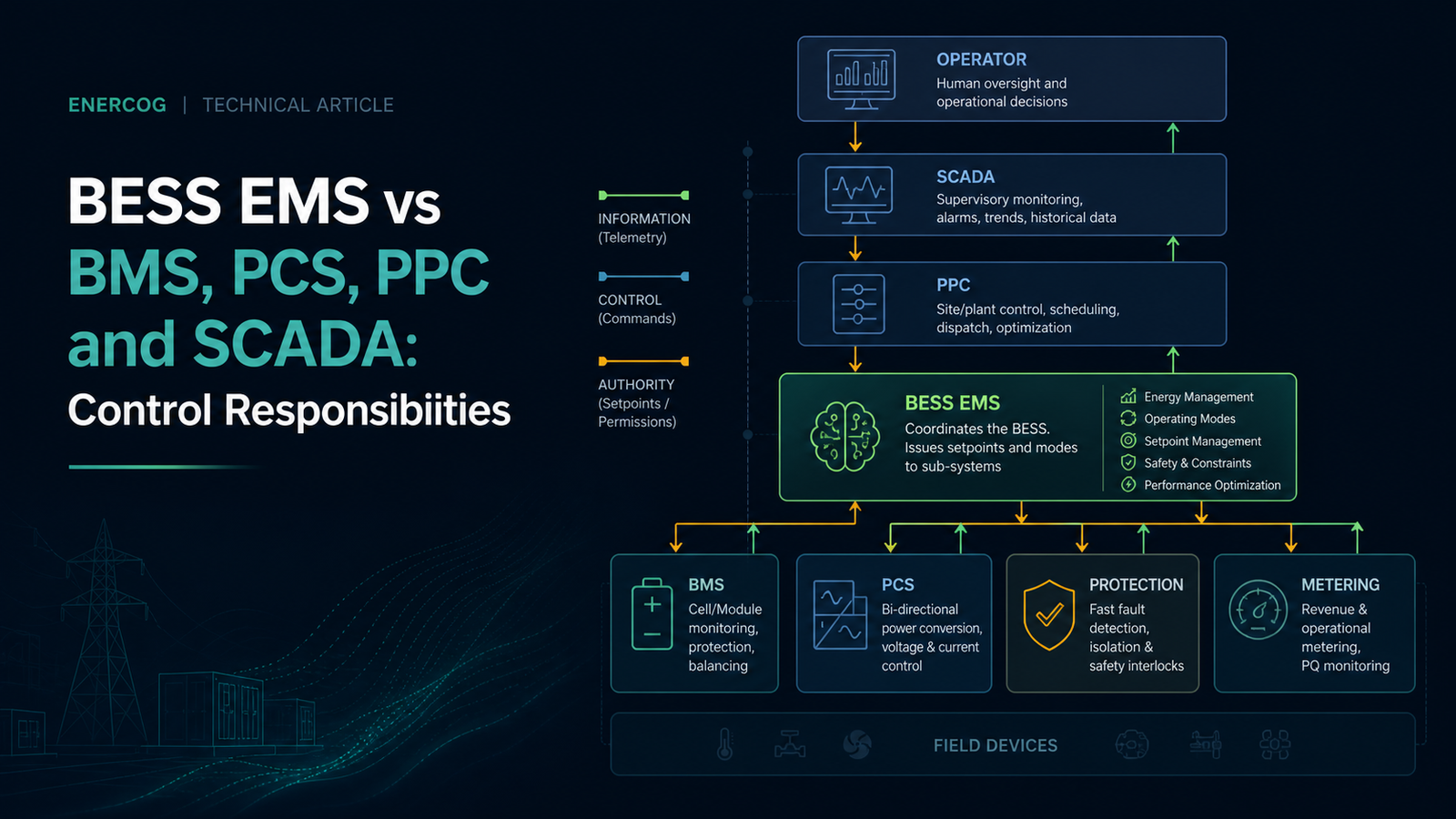
A BESS project needs more than a protocol connection: it needs an agreed responsibility boundary. BESS EMS, BMS, PCS, PPC, SCADA, protection and the operator each have different roles. Making those roles explicit reduces ambiguity during integration, commissioning and operations.
| System or role | Typical responsibility | Boundary to confirm |
|---|---|---|
| BMS / battery OEM | Cell/rack measurement, local limits, trips, protection and OEM safe states. | What overrides supervisory commands and what data is exposed? |
| PCS / plant controller | Inner loops, equipment sequences, permissives and configured local limits. | Which setpoints may be received and how are they acknowledged? |
| BESS EMS | Schedules, operating modes, reserves, objectives, allocation and approved supervisory workflow. | What is advisory versus executable, and at what authority? |
| PPC | Plant/grid objective handling where included in the architecture. | How does PPC priority relate to BESS EMS in each mode? |
| SCADA / historian | Telemetry, alarms, events, reporting and workflow visibility. | What command transport, quality and audit role does SCADA have? |
| Protection / metering / utility | Independent protection, authoritative measurement and external requirements. | What remains outside EMS control and who owns the interface? |
| Owner / operator | Operating policy, approvals, override/restoration decisions and procedures. | Who authorises mode changes and restart? |
Why this matters to operating strategies
Peak shaving, arbitrage, tariff-window operation, grid firming, reserve policy and dispatch allocation are only credible when their command path, limits, local override and fallback are defined. A BESS EMS should not bypass battery or PCS protection, and a SCADA visualisation alone does not make an economic optimisation function available.
The minimum control-review questions
- Which system owns each operating mode, command, limit and restoration action?
- What data-quality, freshness, interlock and local/remote conditions apply?
- What happens on a rejected command, communication loss or controller restart?
- What evidence will FAT/SAT and handover require?
Command lifecycle and fallback
A supervisory command should have a visible lifecycle: requested, validated, authorised, transmitted, acknowledged, effective, actual, expired or rejected. The project needs to define the required preconditions, limits, interlocks, freshness checks, approval path and audit evidence. A controller must also have a defined response when a command source, data source or endpoint becomes unavailable.
These are design and commissioning questions, not an assertion that every interface can execute every command. The confirmed command matrix remains the authority for the named plant.
Use this guide during FAT/SAT
Test the agreed boundary with named scenarios: normal operation, mode change, setpoint rejection, stale data, loss of communications, local override, protection/BMS intervention and restoration. Record the observed response against the approved acceptance criteria and handover it with the project evidence.
This guide explains the control boundary. Use the broader EMS entry point for solar, BESS and hybrid-plant operating questions; see BESS EMS control and integration for BESS use cases; use the integration-readiness checklist for the project input set; and review India-built BESS EMS evidence when a tender or RFQ asks for origin or manufacturing documentation.
BESS EMS control responsibilities in a project review
Use this BESS EMS control-responsibilities review when the project team is turning a functional design into a testable command matrix. Start with the operating objective, then identify the authoritative measurement, the receiving controller, the local permissive, the acknowledgement and the fallback for each command. The BESS EMS may coordinate schedules, operating modes, reserves and dispatch allocation, while the BMS and PCS retain their validated local limits and protective functions. PPC, SCADA, metering, protection and the operator may have separate authority depending on the approved architecture. Record the boundary as an interface decision rather than assuming that a protocol connection proves execution capability. For broader battery-storage context, see the IEA batteries and secure energy transitions report.