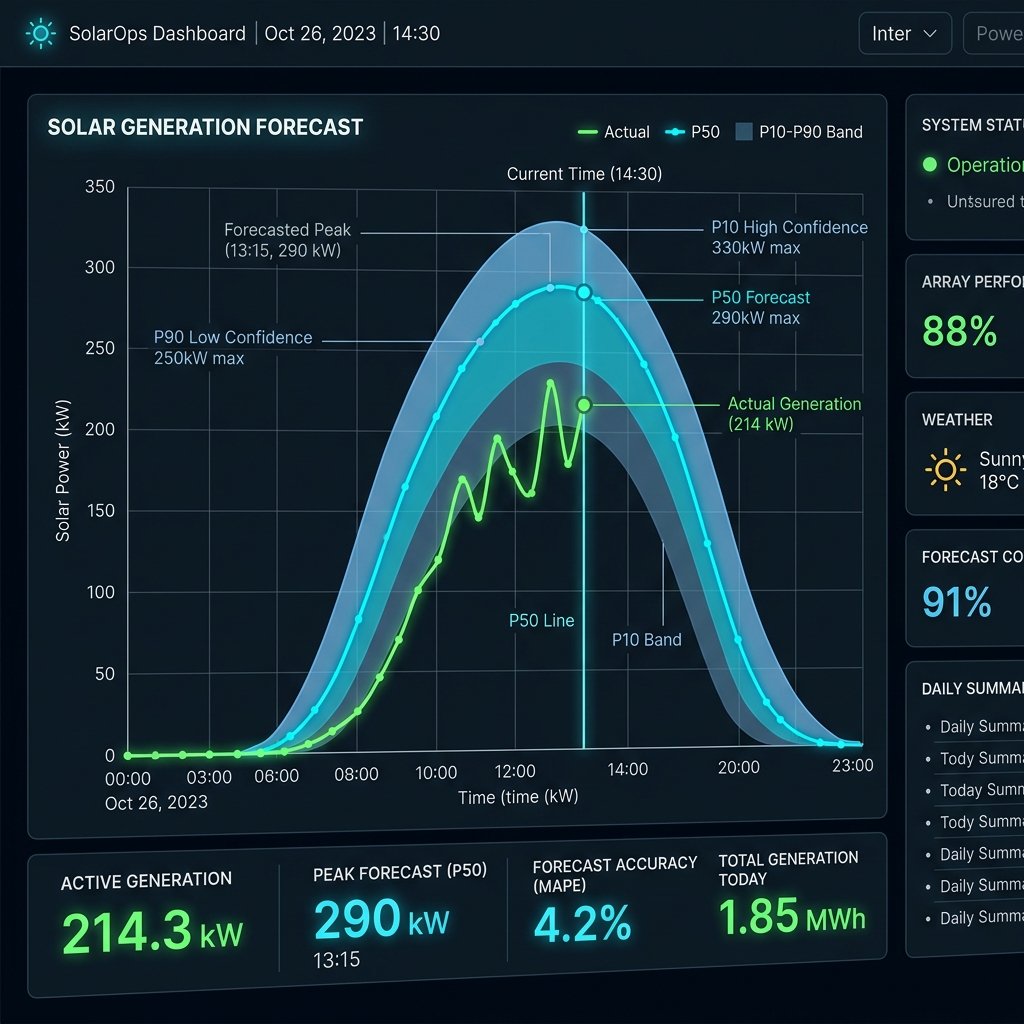
Probabilistic Solar Forecasting (P50/P90) vs. Single-Curve Models: Mitigating High-Risk Grid Deviations for Indian IPPs
Under the tightening grid codes in India, deterministic, single-curve solar forecasting models are exposing Independent Power Producers (IPPs) to severe financial penalties. To manage the new ±5% Deviation Settlement Mechanism (DSM) limits, operators must transition to probabilistic forecasting (P10/P50/P90 probability bands) integrated with dynamic edge control.
The Fallacy of the Single-Curve Forecast
Traditional solar forecasting models output a single curve—a deterministic estimation of power generation for the next day. This single curve represents a best-guess scenario, typically a P50 estimate (meaning there is a 50% chance generation will be above or below this line). However, a single line completely fails to express weather uncertainty. It treats a clear sunny day and a highly volatile, partly cloudy day with equal confidence. For a 100 MW solar plant under the ±5% CERC DSM rules, this lack of uncertainty modeling is extremely risky.
What is Probabilistic Solar Forecasting?
Probabilistic solar forecasting does not just guess a single number. Instead, it generates a range of possible generation outcomes, each associated with a specific probability of occurrence (known as confidence intervals or exceedance probabilities):
- P90 Forecast (Conservative): The generation level that has a 90% probability of being exceeded. This represents the lower boundary of expected generation. Useful for avoiding over-scheduling.
- P50 Forecast (Median): The generation level that has a 50% probability of being exceeded. This is the traditional standard.
- P10 Forecast (Optimistic): The generation level that has a 10% probability of being exceeded. This represents the upper boundary of expected generation.
Comparing Deterministic and Probabilistic Forecasting
| Metric / Feature | Deterministic (Single-Curve) Models | Probabilistic (Multi-Band) Models (Enercog Cortex) |
|---|---|---|
| Uncertainty Representation | None (single line) | Dynamic probability bands (P10, P50, P90) |
| Risk Mitigation Strategy | Reactive (wait for deviation to occur) | Proactive (schedule based on risk tolerance) |
| Rescheduling Lead Time | Delayed (often misses the 6-block ahead window) | Optimized (identifies deviation risks blocks in advance) |
| BESS Charging Efficiency | Sub-optimal (no reserve planning) | High (coordinates BESS state-of-charge with risk bands) |
Using Probability Bands to Optimize BESS Dispatch
When co-located with a Battery Energy Storage System (BESS), probabilistic forecasting becomes a powerful tool. Instead of waiting for a deviation to occur and dumping battery power reactively, the Energy Management System (EMS) can plan ahead. For example, if the Cortex AI engine predicts a wide spread between P10 and P90 (indicating high weather volatility), the Synapse EMS can maintain a higher State of Charge (SoC) in the BESS to act as a buffer. If the spread is narrow (indicating high weather certainty), the BESS can be utilized for arbitrage or ancillary services.
“Single-curve forecasting is like driving in heavy fog without headlights. You only react when you hit an obstacle. Probabilistic forecasting gives you a map of the fog, allowing you to slow down and prepare before you hit a patch of low visibility,” says Anand Meshram, CEO of Enercog Innovations.
To discover how Enercog can help secure your solar plant’s compliance under the tightening Indian grid codes, read our solutions for generation forecasting and learn more about our Synapse EMS.