Managing the ±5% Solar DSM Limit: Algorithmic Scheduling and Edge-Telemetry Strategies for Indian IPPs
Under the CERC Deviation Settlement Mechanism (DSM) Regulations 2024, the tolerance band for solar power deviations was tightened from ±10% to ±5% starting April 1, 2026. To avoid severe grid deviation penalties, Indian Independent Power Producers (IPPs) must transition from coarse cloud-based forecasts to real-time, edge-telemetry-driven intra-day scheduling and dynamic battery storage dispatch.
The Financial Reality of the ±5% Deviation Limit
As solar penetration in the Indian grid crosses critical thresholds, grid stability is no longer just a technical issue—it is a financial one. Following the transition on April 1, 2026, deviations beyond the ±5% band incur penal rates tied directly to the system marginal price (SMP) or the area clearing price (ACP). For a 100 MWp solar asset in high-irradiance zones like Rajasthan or Gujarat, a single sudden cloud transient can swing output by 30 MW within a few minutes. If this swing is not forecasted and rescheduled, the daily deviation settlement charges can easily leak ₹50,000 to ₹2,00,000 in net margins.
Why Cloud-Only Forecasting Models Fail
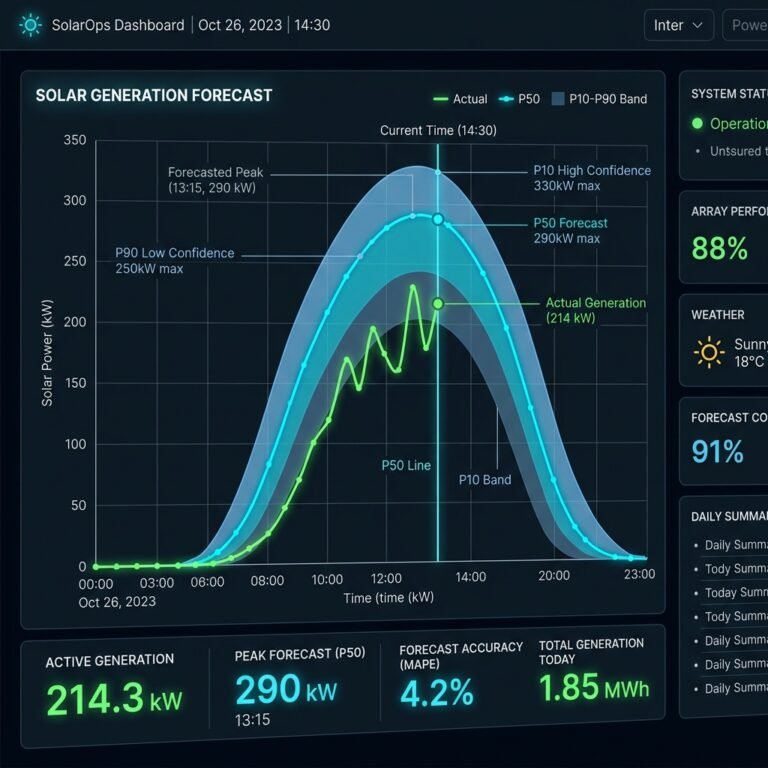
Most commercial forecasting models rely on coarse satellite-derived cloud motion vectors. While useful for day-ahead estimates, they lack the spatial and temporal resolution required to capture intra-hour local weather dynamics. Numerical Weather Prediction (NWP) updates typically operate on 3-hour cycles, completely missing micro-climatic cloud formations. When a localized cloud front covers a solar plant, inverter-level generation drops precipitously in seconds, not hours.
Comparing Forecasting Architectures
| Feature | Traditional Cloud-Only Models | Edge-Integrated Models (Enercog Clarity) |
|---|---|---|
| Source Data | NWP + Satellites | NWP + Local Pyranometers + Inverter Status |
| Update Frequency | Day-ahead / 1-hour intervals | Dynamic 15-minute blocks (intra-hour) |
| Mean Absolute Error (MAE) | 8% to 12% | 3.5% to 5.5% (Within CERC limits) |
| DSM Penalty Risk | High (vulnerable to localized weather) | Low (actively rescheduled and mitigated) |
Mitigating Deviations via Edge-Telemetry and Re-Scheduling
Indian grid codes allow IPPs to revise their injection schedules up to 16 times a day (with a 6-block ahead lead time). The key to avoiding deviation charges is utilizing local edge telemetry. By feeding real-time global horizontal irradiance (GHI) sensors, module back-temperature monitors, and active power outputs from inverter groups into an edge-computing gateway, operators can dynamically adjust their intra-day schedule before deviation thresholds are breached. Enercog Clarity integrates this local telemetry with cloud forecasting models, reducing Mean Absolute Error (MAE) from 9% to under 4.5%.
BESS Dispatch for Deviation Absorbency
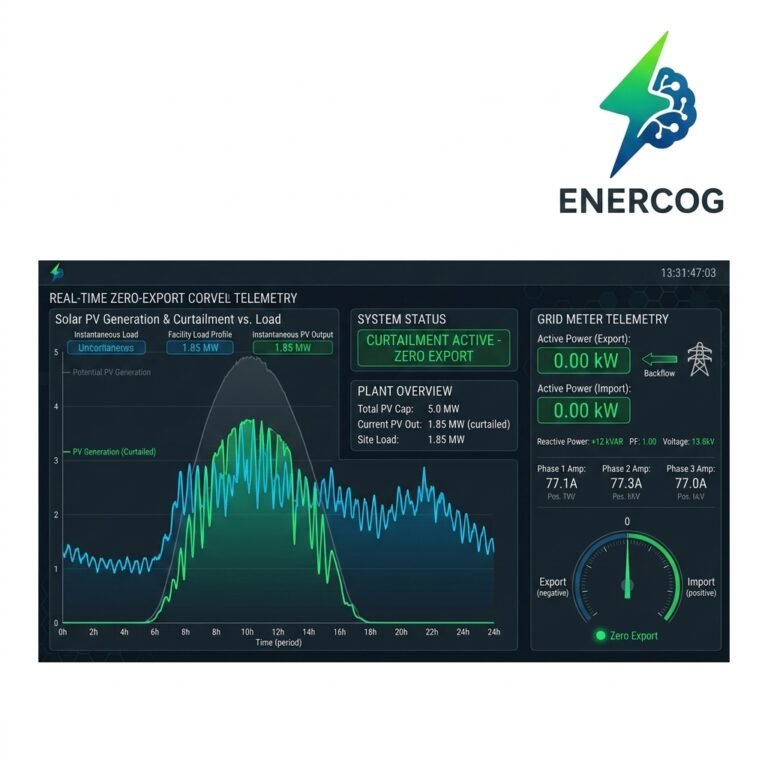
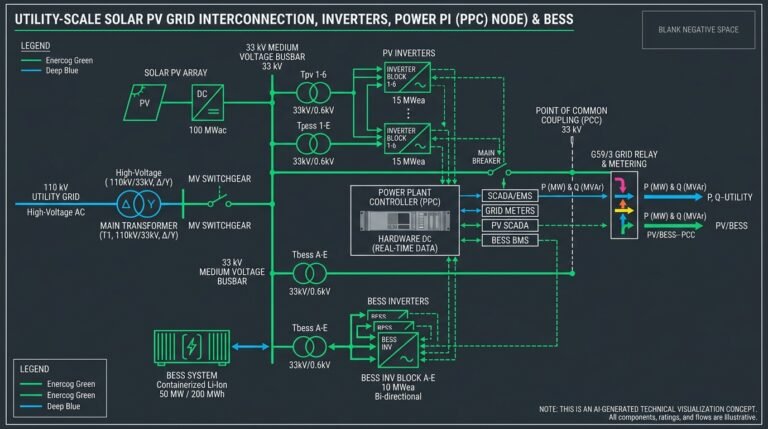
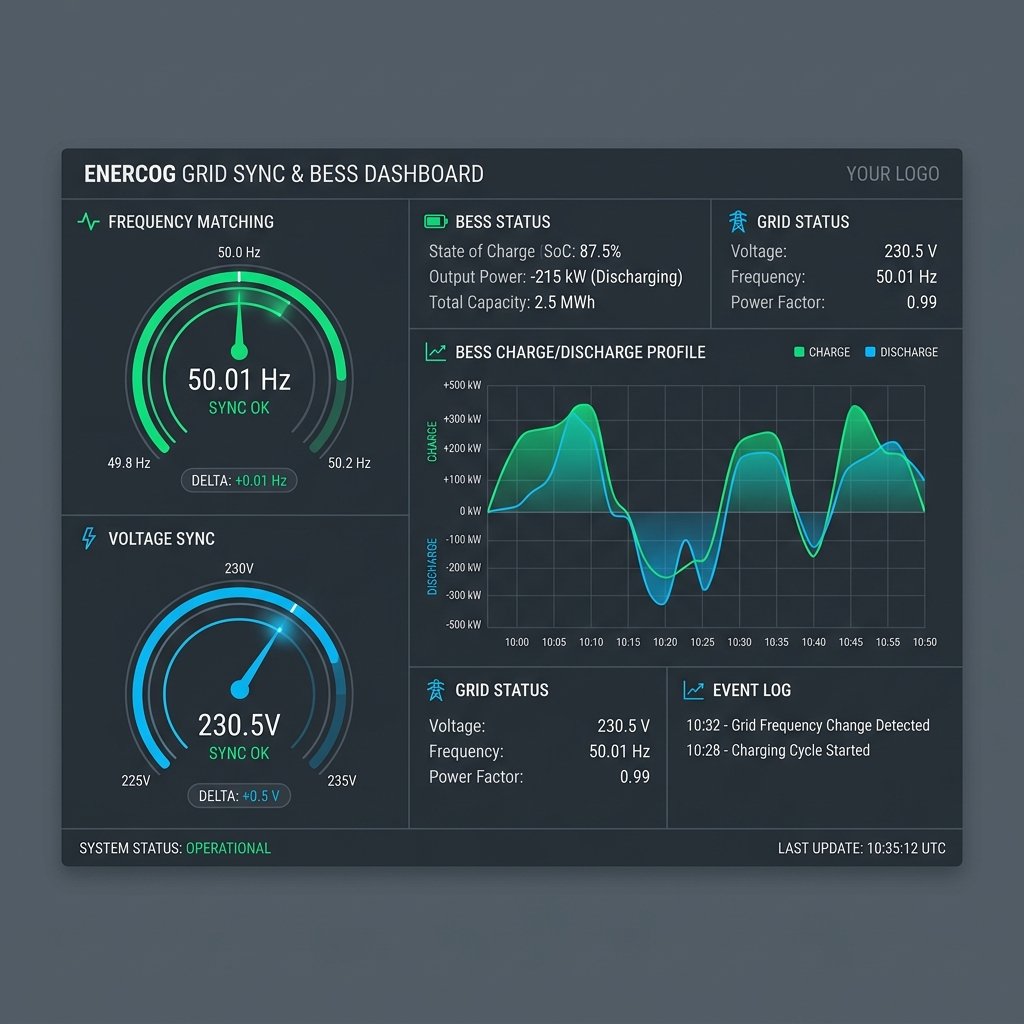
When physical weather variations happen faster than the 1.5-hour rescheduling window, co-located Battery Energy Storage Systems (BESS) act as the physical shock absorber. An intelligent Energy Management System (EMS) monitors the net injection at the pooling substation and compares it to the active grid schedule. The BESS is dynamically commanded to charge during over-generation and discharge during cloud dropouts on a sub-second control loop.
“Maintaining grid compliance under a ±5% tolerance requires absolute synchronicity between forecasting and physical dispatch. If your edge controller does not talk to your forecast model in real-time, you are simply playing a guessing game with deviation penalties,” notes Anand Meshram, CEO of Enercog Innovations.
To learn how Enercog is helping IPPs stay compliant, read our solutions for generation forecasting and our BESS-integrated Synapse EMS.