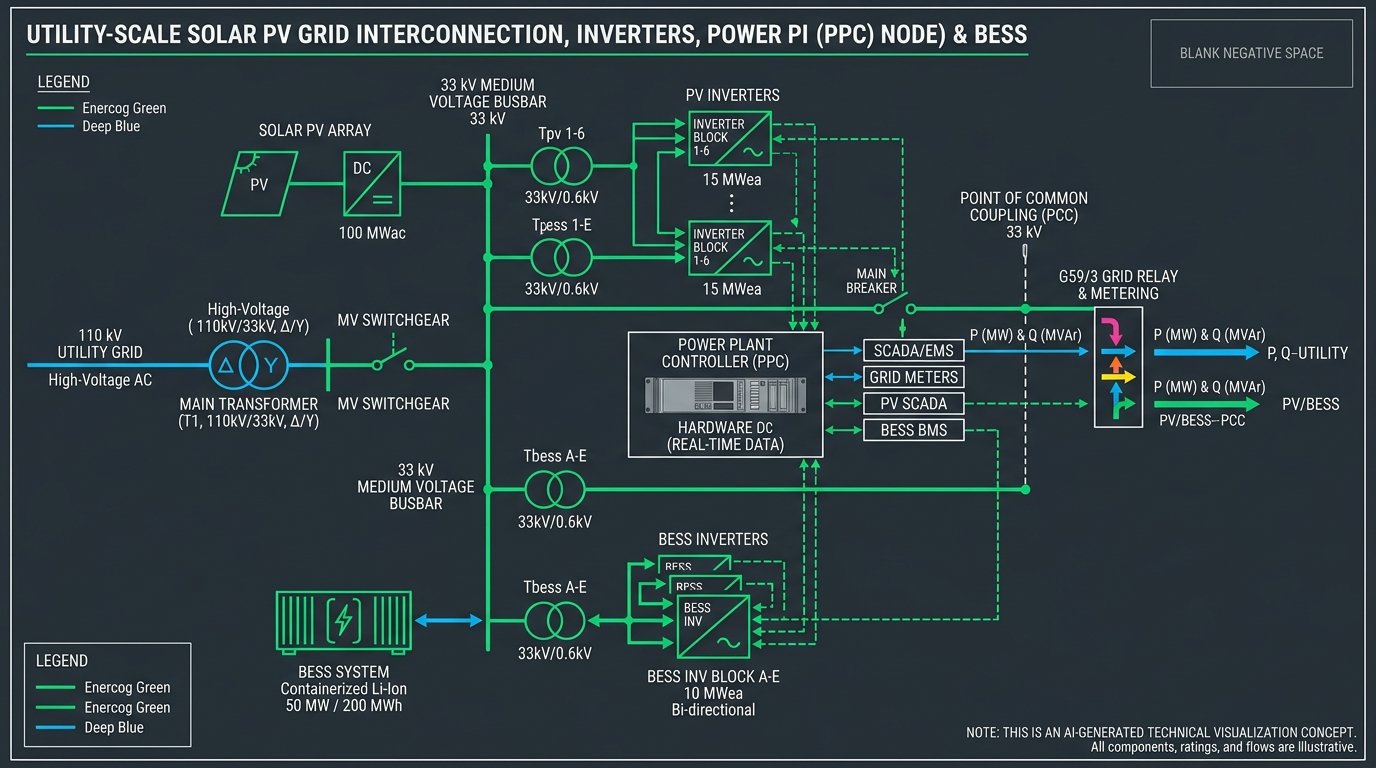
BESS-Integrated Power Plant Control under MSEDCL and GUVNL ToD Tariffs: Algorithmic Co-Optimization for Indian C&I Solar Assets
Evolving Time-of-Day (ToD) tariffs and strict energy storage mandates are redefining the financial metrics of solar installations across India. To prevent power generation curtailment and mitigate peak-hour billing penalties, commercial and industrial (C&I) solar plant operators must transition from static grid-tied configurations to dynamic, edge-controlled battery storage systems integrated with real-time active and reactive power scheduling.
The Operational Impact of Evolving Time-of-Day (ToD) Tariffs
MSEDCL and GUVNL ToD tariffs impose peak surcharges up to 20% and restrict banking to same-slot utilization, reducing the financial yield of standalone solar. Integrating Battery Energy Storage Systems (BESS) allows commercial and industrial (C&I) consumers to store cheap daytime solar power and dispatch it during peak hours to avoid high grid tariffs.
Under the MSEDCL tariff structure in Maharashtra, power consumed during the evening peak window (17:00 to 24:00) incurs a significant surcharge of approximately 20%. Conversely, daytime generation during the solar window (09:00 to 17:00) receives a rebate. The critical challenge is the same-slot banking restriction: excess solar power exported to the grid during the day cannot be banked to offset high-cost evening consumption. In Gujarat, GUVNL has similarly structured Time-of-Use (ToU) incentives to encourage daytime utilization while penalizing peak demand, leaving C&I assets exposed to rising grid operational costs if they cannot shift their load profiles.
Meeting the New MSEDCL BESS Mandate for C&I Solar
Effective April 1, 2026, MSEDCL mandates that new rooftop, captive, and open-access solar installations exceeding 100 kW must integrate BESS capacity equivalent to at least 50% of the solar capacity with a minimum 2-hour discharge duration. A 200 kWp solar array must deploy a 100 kW / 200 kWh battery storage system.
This mandate aims to address grid instability caused by rapid renewable integration. To ease the immediate CAPEX burden, the Union Budget 2026 has allocated ₹1,000 crore under the Viability Gap Funding (VGF) scheme for BESS projects and rationalized Basic Customs Duties on lithium-ion battery inputs. Additionally, a temporary exemption from the Approved List of Models and Manufacturers (ALMM) for net-metering and open-access projects remains active until December 31, 2026. This allows developers to source high-efficiency components while standardizing their grid readiness infrastructure.
Comparative Analysis of Solar-Plus-BESS Economics
Co-optimizing solar and BESS assets yields different payback profiles across Maharashtra and Gujarat. While MSEDCL installations rely on peak-shaving and compliance to justify BESS investments, GUVNL installations leverage Time-of-Use tariff arbitrage and high-capacity open-access provisions to maximize grid revenue.
| Metric / Policy Parameter | Maharashtra (MSEDCL) | Gujarat (GUVNL) |
|---|---|---|
| BESS Mandate | Mandatory for solar >100 kW (50% capacity, 2-hour discharge) | Optional (driven by competitive bidding and arbitrage) |
| Banking Structure | Restricted to same-slot utility billing window | Regulated wheeling and banking under Solar Policy 2026 |
| Peak Tariff Premium | ~20% premium surcharge (17:00 to 24:00) | Dynamic Time-of-Use peak demand rates |
| Budget 2026 Eligibility | VGF allocation eligible + duty rationalization benefits | VGF allocation eligible + stand-alone storage hub projects |
| Key Financial Driver | Avoidance of peak surcharges and same-slot banking losses | Time-of-Use price arbitrage and peak-load management |
Algorithmic Dynamic kVAr Control vs. Uniform Allocation
Traditional power plant controllers dispatch uniform reactive power (kVAr) commands to all inverters, causing uneven thermal stress and accelerated degradation. Enercog Cortex AI dynamically allocates kVAr targets based on real-time inverter health, string soiling, and operating temperatures, extending inverter life while maintaining grid compliance.
Maintaining a stable power factor at the Point of Common Coupling (PCC) is critical under CEA grid connectivity standards. DISCOMs enforce strict power factor limits (0.95 lagging to 0.95 leading) to prevent voltage instability. While modern inverters possess latent reactive power capacity, distributing the reactive load uniformly across all units leads to localized overheating. The Enercog Power Plant Controller (PPC) running on the Synapse Edge iRTU executes sub-second closed-loop control to monitor active and reactive power at the PCC meter. This local gateway communicates with the Cortex AI cloud to dynamically distribute kVAr setpoints, optimizing the thermal profile of individual inverter strings. Operators monitor this active telemetry in real time through the Clarity UI dashboard, maintaining full compliance with CERC DSM deviation limits (±5%) and MSLDC reporting protocols.
“Uniform kVAr dispatch is a silent failure point in modern utility SCADA systems. By forcing a thermally stressed inverter to inject reactive power, you accelerate capacitor failure. Our closed-loop PPC dynamically coordinates with Cortex AI to shift the reactive load to under-utilized, cooler inverters,” notes Shrikant Meshram, founder of Enercog Innovations.
Integrating a high-performance Solar SCADA system with localized PPC capabilities ensures long-term operational health for C&I assets while satisfying state grid telemetry mandates.
SOP: Commissioning BESS-PPC Co-Optimization
Commissioning a BESS-integrated Power Plant Controller requires systematic validation of edge telemetry, control loop response, and grid safety protocols. Following a structured five-step commissioning procedure ensures that both active power throttling and reactive power compensation loops operate within the required response times without grid-trip risks.
- Edge Telemetry Mapping: Connect the PCC multi-function energy meter to the Synapse Edge iRTU via RS-485 Modbus RTU or TCP/IP. Confirm that current transformers (CT) and potential transformers (PT) are calibrated to read active power (P), reactive power (Q), and power factor (PF) accurately.
- BESS BMS Integration: Register the Battery Management System (BMS) and Power Conversion System (PCS) registers in the Synapse controller. Set communication parameters to extract state-of-charge (SoC), cell temperatures, and DC voltage limits.
- Closed-Loop PID Tuning: Configure the PID control constants on the PPC. Run transient tests to confirm that reactive power adjustment signals are dispatched to inverters and BESS within 500ms to 1000ms from detecting a grid voltage swing.
- Time-of-Day Dispatch Logic Test: Input the MSEDCL or GUVNL ToD tariff schedules into Clarity UI. Simulate the transition times (e.g., 17:00 hours) to verify that the BESS automatically stops charging from solar and begins discharging to meet captive loads.
- Fail-Safe Logic Verification: Simulate a complete communication link disconnection between the Synapse iRTU and the PCC meter. Verify that the PPC commands all inverters and the BESS to return to safe, default unity power factor settings within 2 seconds.