BESS EMS Integration-Readiness Checklist
A BESS EMS review is most useful when the plant evidence is available before the engineering workshop. This checklist helps the project team prepare the decisions that determine the real integration scope, command authority and commissioning method.
1. Plant and commercial context
- Project type, site stage, capacity and target commissioning date.
- Operating objectives: peak management, arbitrage, schedule, reserve, solar shifting, grid firming, grid dispatch or another approved use case.
- Authoritative meter, tariff or external dispatch inputs, where relevant.
2. Architecture and interfaces
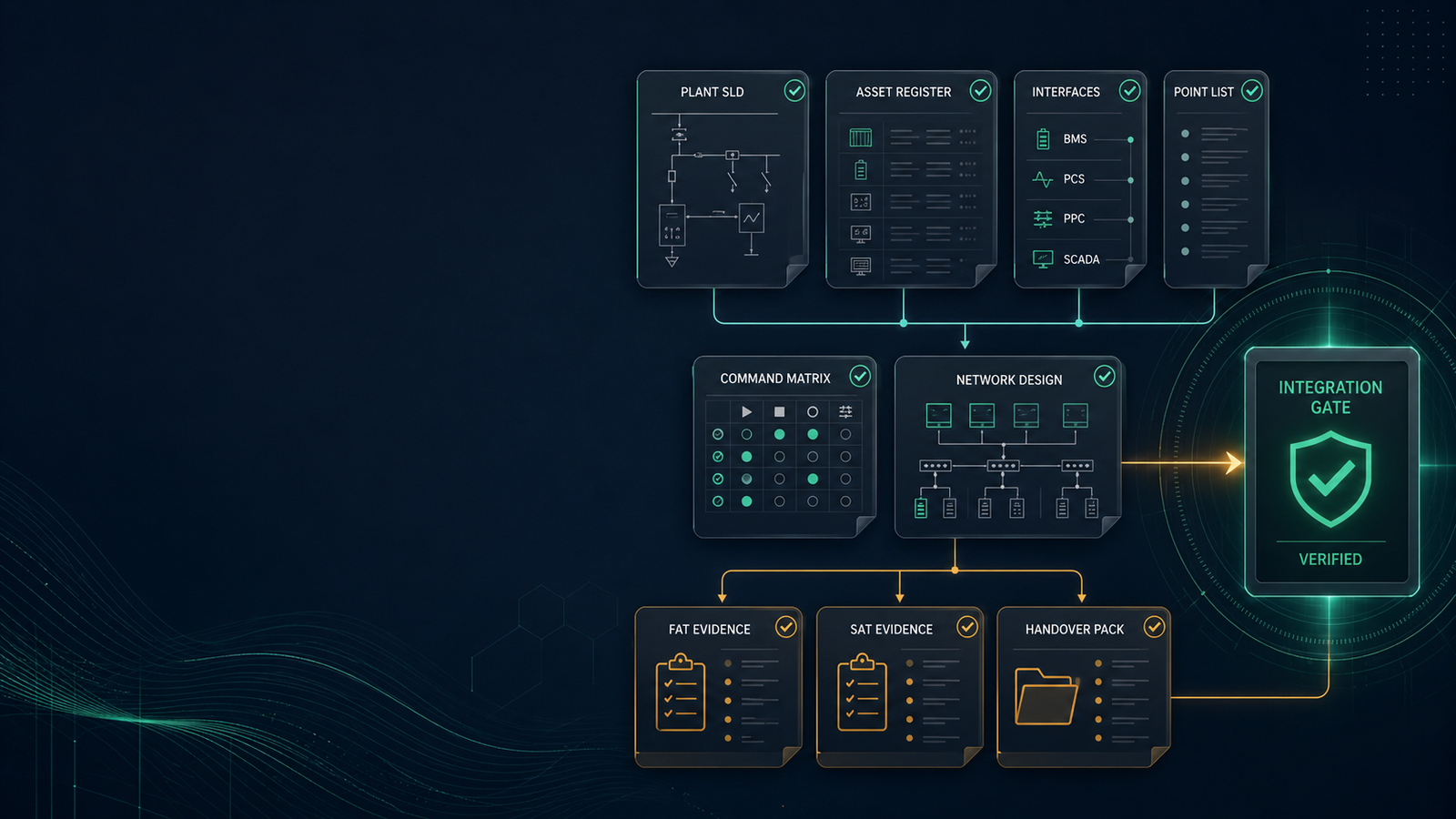
- Approved SLD, asset register and plant topology.
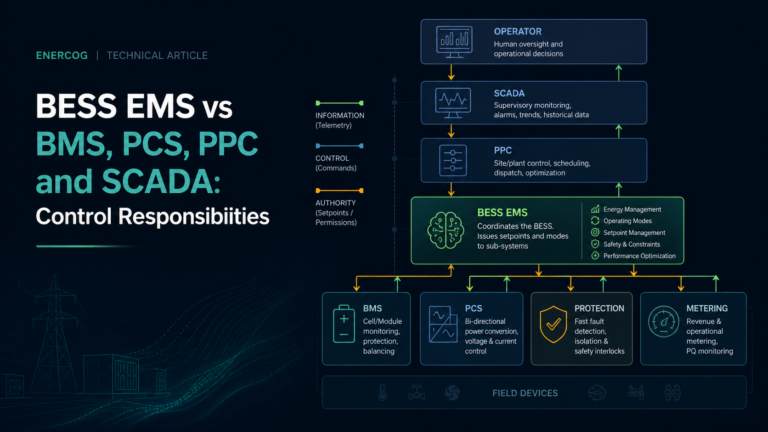
- BMS, PCS, PPC, SCADA, meter and protection equipment details.
- OEM interface documents, protocol/register maps, firmware information and confirmed read/write scope.
- Network design, endpoints, gateway inventory and time architecture.
3. Control, safety and operating policy
- Control philosophy, command matrix, interlocks, permissives and local/remote rules.
- Operating modes, priority/arbitration rules, SoC windows, reserve policy and restoration process.
- Fallback behaviour for stale data, command rejection, endpoint loss, controller restart and protection/BMS intervention.
4. Data, test and handover evidence
- Point list, alarm policy, quality/freshness requirements and event/audit needs.
- FAT/SAT method, acceptance criteria, defect process and witnessed test responsibilities.
- Role/permission design, operating procedure, training and handover records.
5. Turn gaps into review decisions
Use the checklist to separate confirmed inputs from assumptions and open decisions. For each gap, identify the owner, required evidence, impact on scope and the point at which it must be closed. This protects the project from treating a preliminary interface or mockup as a commissioned control function.
6. What good FAT/SAT evidence looks like
For each approved operating scenario, the record should show the initial state, requested action, required preconditions, command path, acknowledgement, actual response, alarms/events, fallback behaviour and acceptance result. The exact test method and criteria remain project-specific.
When to start the review
Start as early as the available engineering evidence permits. A partial package can still identify dependencies, but unverified interfaces, scope or command rights must stay explicitly open until they are confirmed by the relevant project owner or OEM documentation.
A missing item is not a reason to guess. It should be recorded as a project input, assumption or open engineering decision. Use the broader EMS entry point for system-level context, BESS EMS control and integration for BESS operating scope, and the responsibility guide for the control boundary. If an India-built requirement is part of procurement, cross-check the evidence questions in India-built BESS EMS: tender documentation.
BESS EMS integration readiness: evidence to close
A BESS EMS integration-readiness review is strongest when every open item has an owner, source, status and acceptance test. Link the single-line diagram and point-of-interconnection assumptions to the command matrix, network design, tag list, time synchronisation, alarm philosophy and operating modes. Then identify what must be proven during FAT, what requires site conditions during SAT, and what belongs in the handover pack. A project should also state what happens when a value is stale, a command is rejected, a device is unavailable or local protection intervenes. This checklist does not replace the named project specification; it helps the team expose missing inputs before configuration and commissioning. For broader battery-storage context, see the IEA batteries and secure energy transitions report.
Keep the checklist practical by assigning a named evidence owner and a review date to each interface, mode, alarm, limit and test case. That makes the integration review useful to engineering, commissioning and procurement without implying that an unverified item is complete.
This evidence-led sequence also keeps scope, assumptions and approval status visible to the project team.